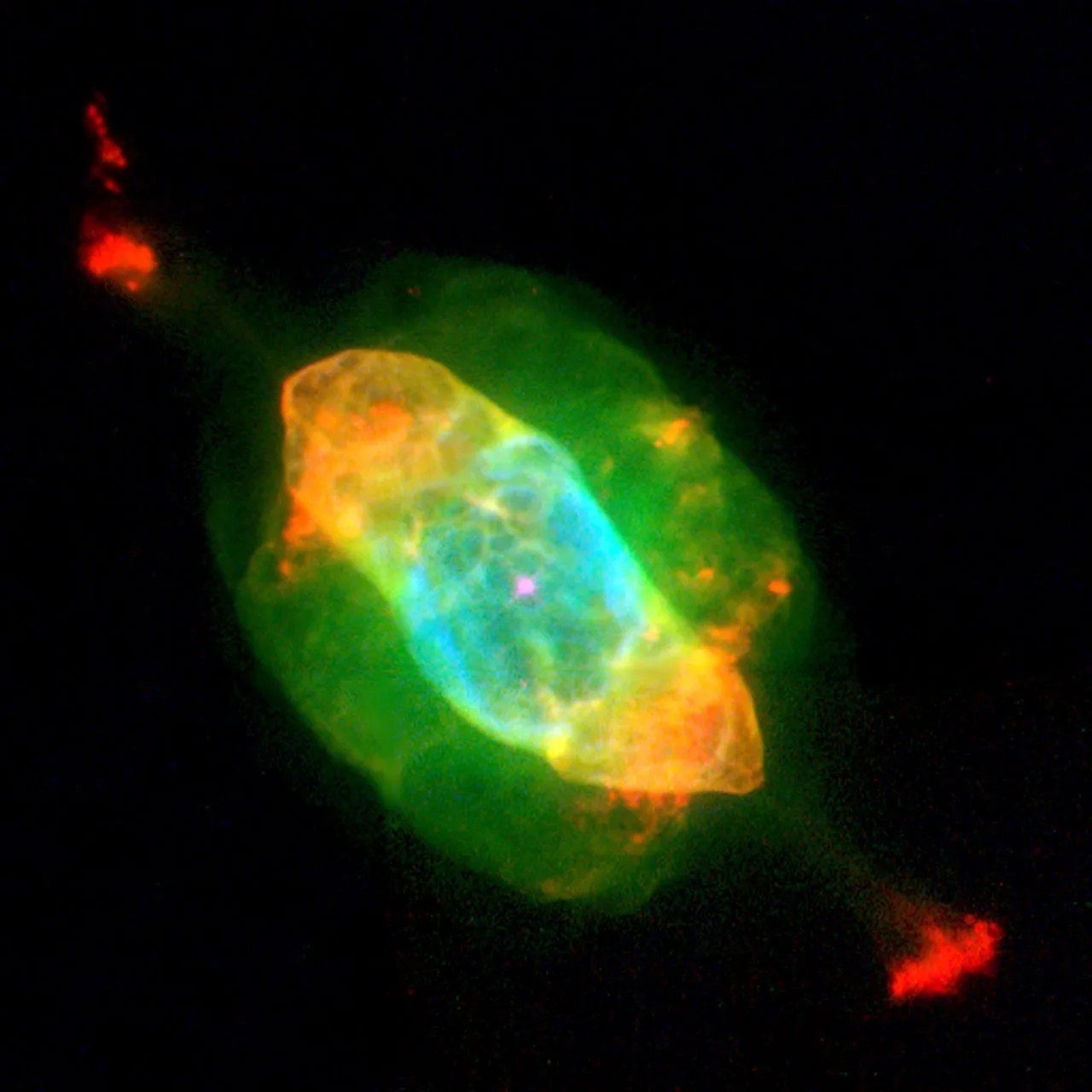
Saturn Nebula
Nebula in Aquarius · 5,200 light-years
🔭 Explore Saturn Nebula in the 3D map →View Saturn Nebula images →| Type | Nebula |
|---|---|
| Constellation | Aquarius |
| Right ascension | 21h 04m 11s |
| Declination | −11° 22′ |
| Object distance | 5,200 light-years |
| Apparent magnitude | 8 |
| Apparent size | 0.7′ (arc-minutes) |
| Approx. true diameter | 1.1 light-years across |
| Also known as | C55 · NGC 7009 |
Although it appears about 0.7′ wide on the sky, its real span is roughly 1.1 light-years — the difference is a measure of how far away it lies.
Observing Saturn Nebula
Saturn Nebula lies in the constellation Aquarius and is best placed in the evening sky around August. Its maximum altitude above the horizon depends on your latitude. Lying near the celestial equator, it can be seen from both hemispheres. A small backyard telescope will show it; binoculars may hint at it under dark skies. Note that the listed magnitude is spread across the whole object — diffuse galaxies and nebulae are often harder to see than the number alone suggests, so dark, moonless skies help a great deal.
See Saturn Nebula in Universe Finder
Open the interactive 3D map to fly to Saturn Nebula and see it in context among the real stars around it. Launch the 3D view →
Sources
- Position, magnitude and angular size from the OpenNGC catalogue (Mattia Verga).
- Object identity cross-referenced with SIMBAD (CDS, Strasbourg).
- Image credits and the original observation source are linked with each photograph.
Related objects
- Orion Nebula — nebula
- Ring Nebula — nebula
- Eagle Nebula — nebula
- Carina Nebula — nebula
- Lagoon Nebula — nebula