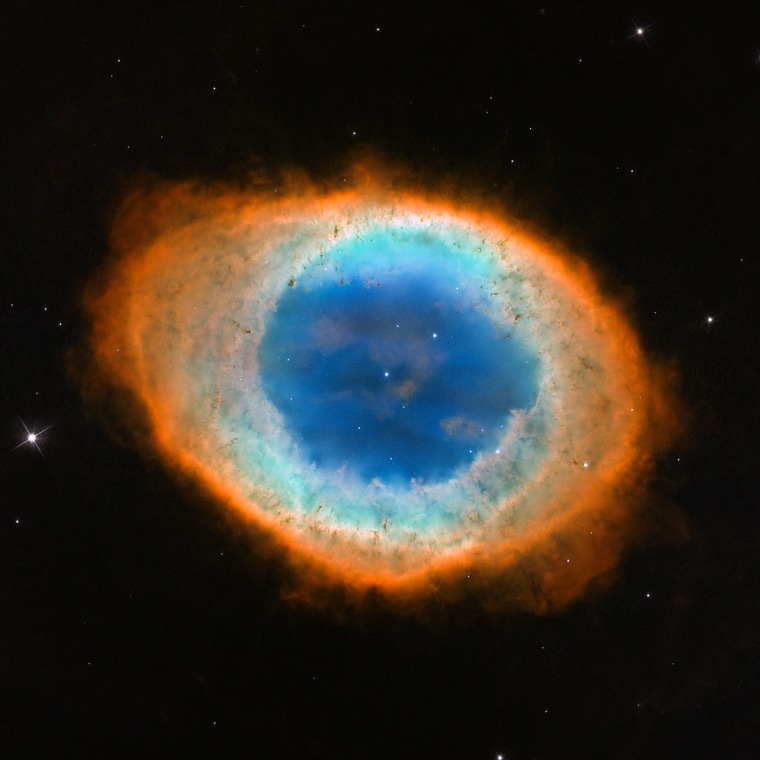
Ring Nebula
Nebula in Lyra · 2,300 light-years
🔭 Explore Ring Nebula in the 3D map →View Ring Nebula images →The Ring Nebula, Messier 57, is not a flat ring. It is the glowing material shed by a dying star, seen almost along its axis: observations model the bright ionized region as barrel-like and a thin molecular envelope around it as a truncated ellipsoid viewed nearly pole-on.
| Type | Nebula |
|---|---|
| Constellation | Lyra |
| Right ascension | 18h 53m 06s |
| Declination | +33° 02′ |
| Object distance | 2,300 light-years |
| Also known as | M57 |
| Imaged by | JWST, Hubble |
Observing Ring Nebula
Ring Nebula lies in the constellation Lyra and is best placed in the evening sky around July. Its maximum altitude above the horizon depends on your latitude. It is best placed for observers in the northern hemisphere, and sits low for those far south. Note that the listed magnitude is spread across the whole object — diffuse galaxies and nebulae are often harder to see than the number alone suggests, so dark, moonless skies help a great deal.
Why a deep shell looks like a ring
The familiar image is a projection. Hubble-era imaging and spectroscopy describe the bright ionized gas as a barrel-like region with lower-density material extending through the centre. Newer carbon-monoxide observations trace a different layer: a thin molecular envelope around the ionized gas, modelled as a truncated ellipsoid viewed almost pole-on.
These are scientific reconstructions rather than a photographed surface. Universe Finder therefore labels the side view as a visualization and distinguishes the bright inner region from the surrounding molecular layer instead of treating either model as a literal three-dimensional photograph.
The exposed core and expanding layers
The bright ring is roughly a light-year across, while a much fainter halo reaches several times farther. The material is still expanding, and its age depends on which layer and model is measured: the bright ionized shell and the surrounding molecular envelope give different dynamical estimates.
At the centre is the exposed stellar core, extremely hot and already cooling toward a white dwarf. Evolutionary models indicate that the original star was somewhat heavier than the Sun. The Ring Nebula is therefore the Sun's kind of ending, but it is not a preview with identical mass or timing.
What Webb revealed in the shell
Webb's infrared images resolve an immense population of dense molecular-hydrogen knots. Their total is an estimate produced by two counting approaches, not a census of individually confirmed objects across an unobscured surface.
Outside the main ring, a sequence of faint arcs may record the influence of a close companion star. That companion is inferred from the arc spacing and has not been directly detected. A much wider red-dwarf companion shares the central star's motion, so combining the measured wide companion with the inferred inner one makes the system likely, rather than certainly, triple.
How to find Ring Nebula tonight
Begin with Vega and find the small parallelogram that outlines Lyra. The Ring Nebula lies about halfway between Sheliak and Sulafat, the two southern stars of that parallelogram.
Binoculars may show only a faint point. A telescope is needed to resolve the smoke-ring appearance, and light pollution, haze, moonlight and local conditions can make the target harder to see.
For a location-aware view, open the Tonight panel in Universe Finder. Find in my sky shows the current direction from your location; Show in 3D returns to the catalogue flight.
The numbers — and how sure we are
Every value below carries its label from the episode research pack: MEASURED (observation-derived), ESTIMATE (model-derived or uncertain), COMPARISON (an analogy for scale), VISUALIZATION (explanatory rendering).
- MEASURED The Ring Nebula, Messier 57, is a planetary nebula in the constellation Lyra — the glowing outer layers cast off by a dying star, and in NASA's words the best-known planetary nebula in the sky.identification settled; also catalogued NGC 6720; 'best-known example of a planetary nebula' and 'most famous of all planetary nebulae' are NASA's own descriptions (1999 Hubble Heritage release)ESA/Webb photo release weic2320 (retrieved 2026-09-05) · NASA Science (retrieved 2026-09-05) · NASA Hubble release (retrieved 2026-09-05) · Universe Finder catalog entry (retrieved 2026-09-05)
- ESTIMATE Hubble observations model the bright ionized gas as barrel-like. Newer carbon-monoxide data trace a thin molecular envelope around it, closer to a truncated ellipsoid seen almost pole-on.These are model reconstructions, not a photographed 3-D surface. Hubble-era imaging and spectroscopy describe the bright ionized region as a distorted doughnut or barrel with lower-density polar lobes. Kastner et al. 2025 use position-velocity CO data to model the thin molecular layer surrounding that ionized gas as a truncated triaxial ellipsoid viewed within about 2 degrees of pole-on. The tracers describe different layers, so the older barrel analogy is retained only for the ionized region.NASA Hubble release (retrieved 2026-09-05) · ESA/Hubble photo release heic1310 (retrieved 2026-09-05) · ESA/Webb photo release weic2320 (retrieved 2026-09-05) · Kastner, Wilner, Ryder, et al. 2025 (retrieved 2026-09-19)
- MEASURED The Ring Nebula is about 2,500 light-years away — 790 parsecs, measured from the Gaia parallax of its central star.Gaia parallax of the central star 1.2696 ± 0.0438 mas ⇒ 790 ± 30 pc ⇒ 2,480–2,670 ly; outreach pages round to 2,000 (NASA/ESA Hubble) or 2,500 (ESA/Webb); the app catalog carries 2,300 — narration says 'about two and a half thousand light-years'Wesson, Matsuura, Zijlstra, et al. 2024 (retrieved 2026-09-05) · ESA/Webb photo release weic2320 (retrieved 2026-09-05) · Universe Finder catalog entry (retrieved 2026-09-05)
- COMPARISON Its light takes about 2,600 years to reach Earth, so we see the Ring Nebula as it was some twenty-six centuries ago.follows the distance: 2,480–2,670 yearsWesson, Matsuura, Zijlstra, et al. 2024 (retrieved 2026-09-05)
- ESTIMATE The bright ring is roughly a light-year across; the faint outer halo spans about three light-years.angular size × Gaia distance: NASA quotes the bright ring at about one light-year across; the bright shell's radius is ~0.1 pc (≈ 0.65 ly across) in Wesson et al., and the full ~4-arcminute nebula including the halo is ~1 pc ≈ 3 ly — cards say 'about a light-year'NASA Hubble release (retrieved 2026-09-05) · Wesson, Matsuura, Zijlstra, et al. 2024 (retrieved 2026-09-05)
- MEASURED The faint central star is the exposed core of the star that made the nebula: about 135,000 kelvin, some three hundred times the Sun's luminosity, and cooling toward a white dwarf.Teff = 1.35×10^5 K and L ≈ 310 L☉ (Sahai et al., cited in Wesson et al. 2024) place the star on the white-dwarf cooling track; its mass is NOT stated here — masses on the cooling track are model-dependent and live in ring-nebula.progenitor as an ESTIMATEWesson, Matsuura, Zijlstra, et al. 2024 (retrieved 2026-09-05) · NASA Hubble release (retrieved 2026-09-05)
- ESTIMATE The star that shed this nebula was somewhat heavier than the Sun — roughly one and a half to two solar masses by the models; about 0.58 solar masses of it remains as the core.model-dependent: evolutionary tracks fitted to the central star's temperature and luminosity give a progenitor of ~1.5 M☉ (González-Santamaría et al. 2021, who also quote a current mass of 0.58 M☉) to ~2 M☉ (Miller Bertolami 2016); Wesson et al. 2024 note the tracks converge on the cooling track so both masses are difficult to determine; NASA's 1999 release says 'greater mass than our own Sun'Wesson, Matsuura, Zijlstra, et al. 2024 (retrieved 2026-09-05) · NASA Hubble release (retrieved 2026-09-05)
- ESTIMATE The age depends on which layer and model is measured: about 4,000 years for the bright ionized shell, and about 6,000 years for the surrounding molecular envelope.Dynamical age is model-dependent size divided by expansion speed. Wesson et al. 2024 adopt about 4,000 yr for the bright ionized shell. Kastner et al. 2025 infer about 6,000 yr for the molecular envelope; their simple ellipsoid dimensions and derived values are uncertain at roughly 10%, and later photoionization acceleration may make the dynamical age an underestimate.Wesson, Matsuura, Zijlstra, et al. 2024 (retrieved 2026-09-05) · NASA Hubble release (retrieved 2026-09-05) · Kastner, Wilner, Ryder, et al. 2025 (retrieved 2026-09-19)
- MEASURED The shell is still expanding at about 20 to 25 kilometres per second.outflow speed falls outward: ≈ 40 km/s in the cavity, 20–25 km/s in the shell, ~15 km/s in the halo (O'Dell et al. 2013a; Martin et al. 2016; Sahai et al. 2012, as compiled by Wesson et al. 2024)Wesson, Matsuura, Zijlstra, et al. 2024 (retrieved 2026-09-05)
- ESTIMATE From Webb's images astronomers estimate roughly 20,000 dense globules of molecular hydrogen in the shell — about 17,500 found by an algorithm, about 25,000 by a manual count scaled to the whole ring — each about 150 times the Earth–Sun distance across.ESTIMATED two ways in Wesson et al. 2024: a peak-finding algorithm (PHOTUTILS) on the F212N image found about 17,500 peaks, likely an underestimate because clumps overlap; a manual count in small regions extrapolated to the full area gives ~25,000 — the paper rounds to 'some 20,000'; characteristic diameter 0.2 arcsec ≈ 150–160 au; density nH ~10^5–10^6 cm^-3Wesson, Matsuura, Zijlstra, et al. 2024 (retrieved 2026-09-05) · ESA/Webb photo release weic2320 (retrieved 2026-09-05)
- ESTIMATE About ten faint, evenly spaced arcs outside the main ring suggest a low-mass companion orbiting the dying star roughly every 280 years, at about the Earth–Pluto distance — inferred from the arc spacing, not yet seen directly.INFERRED, not observed: arc spacing ~1.5 arcsec at 20 ± 5 km/s and 790 pc gives 280 ± 70 yr; for a combined mass of 1.5 ± 0.5 M☉ that is a separation of about 50 ± 15 au; ESA/Webb phrases it as 'comparable to the Earth–Pluto distance'. No companion has been directly detectedWesson, Matsuura, Zijlstra, et al. 2024 (retrieved 2026-09-05) · ESA/Webb photo release weic2320 (retrieved 2026-09-05)
- ESTIMATE A faint red dwarf shares the central star's motion at about 15,000 times the Earth–Sun distance; with the inferred inner companion, the system is likely a triple.the wide companion is a known common-proper-motion star at a projected 15,000 au (0.07 pc), shown by Wesson et al. to be an M2–M4 dwarf (measured); 'triple' adds the close companion INFERRED from the arcs, so the system is 'likely' a tripleWesson, Matsuura, Zijlstra, et al. 2024 (retrieved 2026-09-05)
- COMPARISON A star like the Sun ends this way too: NASA expects the Sun to swell into a red giant and become a white dwarf in about five billion years — though the Ring's star was somewhat heavier than ours.NASA: the Sun will become a red giant and, 5 billion years or so from now, a white dwarf; ESA/Webb calls the white dwarf 'the final evolutionary stage for a star like the Sun'. M57's star was heavier than the Sun, so the line is 'the Sun's kind of ending', never 'this is the Sun'NASA Science (retrieved 2026-09-05) · ESA/Webb photo release weic2320 (retrieved 2026-09-05) · NASA Hubble release (retrieved 2026-09-05)
- MEASURED Antoine Darquier de Pellepoix and Charles Messier both found the Ring Nebula in 1779 while tracking a comet through Lyra.date and discoverers settled (ESA/Webb; NASA credits Darquier de Pellepoix); both were following a comet through LyraESA/Webb photo release weic2320 (retrieved 2026-09-05) · NASA Science (retrieved 2026-09-05)
- MEASURED 'Planetary nebula' is a two-hundred-year-old misnomer: in small telescopes these round glows looked like the disks of planets.historical naming: two centuries ago the round disks of these objects resembled planets in small telescopes (NASA)NASA Hubble release (retrieved 2026-09-05)
- MEASURED In Hubble's view the colours trace elements — helium in the blue centre, hydrogen and oxygen in the inner ring, nitrogen and sulfur in the red rim; Webb's infrared images are false-colour throughout.Hubble composite: blue centre = helium, light-blue inner ring = hydrogen and oxygen, red outer ring = nitrogen and sulfur (NASA); Webb images are infrared and entirely false-colourNASA Science (retrieved 2026-09-05) · ESA/Webb photo release weic2320 (retrieved 2026-09-05)
- MEASURED Look for Vega, then the small parallelogram of stars beside it: the Ring Nebula lies halfway between the parallelogram's two southern stars, Sheliak and Sulafat. At magnitude 8.8, binoculars may show a faint point; use a telescope to resolve the smoke-ring shape.position and magnitude settled (NASA); the two stars are the southern pair of Lyra's parallelogram below Vega; Vega is the fifth-brightest star in the night sky (app catalog mag 0.03) — 'one of the brightest'; binoculars show at most a faint point, a small telescope shows the smoke ringNASA Science (retrieved 2026-09-05) · Universe Finder catalog entry (retrieved 2026-09-05)
- MEASURED Open the Tonight panel in Universe Finder and use your location to see when the Ring Nebula is above your horizon. Choose Find in my sky for the real direction, or Show in 3D to return to the flight.Bound to the current Universe Finder product implementation reviewed on 2026-09-19: Tonight computes object visibility for a saved city or browser location; Find in my sky opens the direction finder; Show in 3D selects and flies to the object. Labels or behavior may change in a future product release.Universe Finder product implementation (retrieved 2026-09-19)
- VISUALIZATION Turning the nebula on its side is a visualization, not a 3-D photograph: the barrel-like form represents the bright ionized region, while the newer carbon-monoxide model adds a thin, truncated ellipsoidal molecular envelope around it.NASA Hubble release (retrieved 2026-09-05) · ESA/Hubble photo release heic1310 (retrieved 2026-09-05) · Kastner, Wilner, Ryder, et al. 2025 (retrieved 2026-09-19)
Questions people ask
Is the Ring Nebula really a ring?
No. The round appearance is a projection produced by looking almost along the structure's axis. Observations model the bright ionized region as barrel-like and the surrounding thin molecular layer as a truncated ellipsoid. Both descriptions are model reconstructions of different layers, not a photographed solid surface.
What is at the centre of the Ring Nebula?
The faint central point is the exposed core of the star that expelled the nebula. It is extremely hot and cooling toward a white dwarf. Models indicate the original star was somewhat heavier than the Sun, so comparisons to the Sun describe a broadly similar evolutionary ending rather than an identical future object.
How far away is Messier 57?
The Gaia parallax of its central star places the Ring Nebula at about twenty-five hundred light-years away. Because of that travel time, the light arriving now shows the nebula as it was roughly twenty-six centuries ago.
Did Webb discover a companion star inside the Ring Nebula?
No close companion has been directly detected. Astronomers infer that one may exist because of the spacing of faint arcs outside the main ring. A separate, much wider red-dwarf companion does share the central star's motion; combining it with the inferred inner companion makes the system likely triple.
How can I find the Ring Nebula tonight?
Find Vega and Lyra's small parallelogram, then look about halfway between Sheliak and Sulafat. A telescope is needed to resolve the ring. Universe Finder's Tonight panel can calculate visibility for your location, Find in my sky can show the direction, and Show in 3D returns to the flight.
See Ring Nebula in Universe Finder
Open the interactive 3D map to fly to Ring Nebula and see it in context among the real stars around it. Launch the 3D view →
Prefer to watch first? Watch the full Ring Nebula episode — a guided 3D flight with chapters, transcript and sources →
Sources
- Position and distance curated from published deep-sky catalogues (Messier / NGC / IC and the astronomical literature).
- Object identity cross-referenced with SIMBAD (CDS, Strasbourg).
- Image credits and the original observation source are linked with each photograph.
Related objects
- Orion Nebula — nebula
- Eagle Nebula — nebula
- Carina Nebula — nebula
- Lagoon Nebula — nebula
- Barbell Nebula — nebula