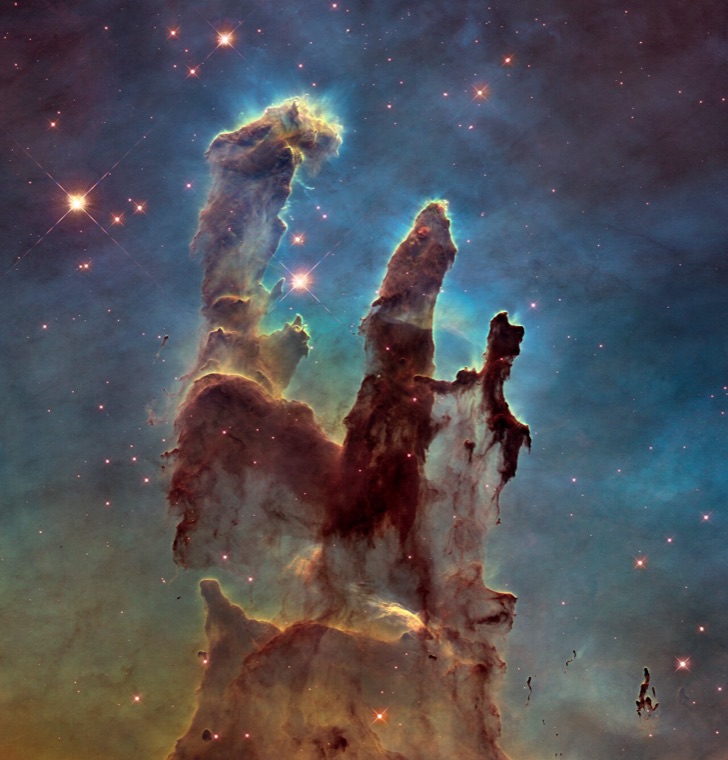
Eagle Nebula
Nebula in Serpens · 5,560 light-years
🔭 Explore Eagle Nebula in the 3D map →View Eagle Nebula images →The Eagle Nebula (M16) is a star-forming region in Serpens about 5,600 light-years away. Inside it stand the Pillars of Creation: columns of cold gas and dust roughly three to four light-years tall, sculpted and slowly eroded by ultraviolet radiation from the young cluster NGC 6611 while new stars form within them.
| Type | Nebula |
|---|---|
| Constellation | Serpens |
| Right ascension | 18h 18m 47s |
| Declination | −13° 47′ |
| Object distance | 5,560 light-years |
| Also known as | M16 · Pillars of Creation |
| Imaged by | Hubble, JWST |
Observing Eagle Nebula
Eagle Nebula lies in the constellation Serpens and is best placed in the evening sky around June. Its maximum altitude above the horizon depends on your latitude. Lying near the celestial equator, it can be seen from both hemispheres. Note that the listed magnitude is spread across the whole object — diffuse galaxies and nebulae are often harder to see than the number alone suggests, so dark, moonless skies help a great deal.
The Pillars are one detail inside the Eagle Nebula
The Pillars of Creation are not the whole Eagle Nebula. They are columns of cold gas and dust inside Messier 16, a much larger star-forming region in Serpens. At the distance measured from Gaia parallaxes of its young cluster, the nebula spans roughly fifty-five by forty-five light-years, while the tallest pillars rise about three to four light-years.
The system lies about five thousand six hundred light-years away. The light arriving now left around 3,500 BCE, before the Great Pyramid was built, so every current view is also a record of an ancient moment in the nebula's evolution.
A photograph of creation and destruction together
Hubble's WFPC2 camera photographed the pillars on April 1, 1995. The image revealed dense pockets at their tips called evaporating gaseous globules, or EGGs: compact knots of gas associated with newborn-star formation. The picture became famous for showing creation, but it also records the structures being dismantled.
Ultraviolet radiation from the hot young stars of NGC 6611 heats the pillar surfaces until gas escapes into space. Measurements put the pillars' present mass at about two hundred Suns and their loss rate at roughly seventy Suns per million years. Dividing those measured quantities gives an estimated remaining lifetime of roughly three million years — not an exact demolition date, but a physical timescale for a temporary structure.
What Hubble and Webb reveal
Hubble returned for its twenty-fifth anniversary with Wide Field Camera 3, recording the pillars in visible light and infrared. The sharper revisit showed a heated fragment flying away from the top edge of the left pillar — visible evidence that the landscape is changing.
Webb's near-infrared camera looked through more of the dust and revealed newly forming stars inside the columns, along with crimson features where jets from young stars shock the surrounding gas. These wavelengths provide complementary measurements, not interchangeable colour versions of one ordinary-eye photograph.
A close flight around the pillars is still a visualization. Spectroscopy measured aspects of their orientation, but dust hides the interiors and the fine three-dimensional geometry remains illustrative rather than photographed.
How to find Eagle Nebula tonight
On an August evening, begin with the Teapot of Sagittarius and sweep binoculars upward along the Milky Way. The Eagle Nebula's cluster appears as a soft glow in Serpens at about magnitude six.
Binoculars can locate the region, but the Pillars of Creation themselves are a large-telescope target. Finding the glow means you have found where the pillars stand even when your equipment cannot separate the famous columns.
Use a dark site and let your eyes adapt before sweeping slowly through the Milky Way. The target is the Eagle Nebula and its embedded cluster, not a miniature version of the processed Hubble photograph.
For current direction and altitude at your location, open Eagle Nebula in Universe Finder and use Tonight. The three-dimensional view then places the star-forming region in context, while its close interior view is explicitly labeled as visualization.
The numbers — and how sure we are
Every value below carries its label from the episode research pack: MEASURED (observation-derived), ESTIMATE (model-derived or uncertain), COMPARISON (an analogy for scale), VISUALIZATION (explanatory rendering).
- MEASURED The Pillars of Creation are columns of cold gas and dust inside the Eagle Nebula — Messier sixteen — a star-forming region in the constellation Serpens.identification and sky position are settledNASA Hubble Messier Catalog (retrieved 2026-08-23) · Universe Finder catalogue (retrieved 2026-08-23)
- MEASURED Gaia parallaxes of the young cluster place the Eagle Nebula about five thousand six hundred light-years away — closer than the seven thousand often quoted.± 7 pc (≈ ± 23 ly), Gaia EDR3 cluster parallax; older public pages round to 6,500-7,000 lyStoop et al. 2023, A&A (retrieved 2026-08-23)
- MEASURED At the Gaia distance, the tallest pillars stand roughly three to four light-years high — a beam of light needs years to climb from base to tip.NASA's 4–5 ly assumes its 7,000-ly distance; angular size rescaled to the adopted Gaia 5,560 ly (×0.79) gives ≈ 3.2–4.0 ly. Derivation in comparisons.json and research.mdNASA Hubble Messier Catalog (retrieved 2026-08-23) · Stoop et al. 2023, A&A (retrieved 2026-08-23)
- MEASURED The pillars are a small feature of the Eagle Nebula, which at the Gaia distance spans roughly fifty-five by forty-five light-years.NASA's 70 × 55 ly assumes its 7,000-ly distance; rescaled to Gaia 5,560 ly (×0.79) gives ≈ 56 × 44 ly, rounded. Projection on the skyNASA Hubble Messier Catalog (retrieved 2026-08-23) · Stoop et al. 2023, A&A (retrieved 2026-08-23)
- MEASURED Hubble's WFPC2 camera first photographed the pillars on April 1, 1995 — Jeff Hester and Paul Scowen's image became one of the most famous astronomical photographs ever taken.documented observation: date, instrument and authors are settled historyNASA/STScI 1995 release (retrieved 2026-08-23) · Astronomy.com (retrieved 2026-08-23) · ESA/Hubble heic1501 (retrieved 2026-08-23)
- MEASURED The 1995 image revealed dense pockets at the pillar tips — evaporating gaseous globules, or EGGs — compact knots of gas serving as incubators for newborn stars.named and described in the 1995 discovery release; individual EGG fates varyNASA/STScI 1995 release (retrieved 2026-08-23)
- MEASURED For Hubble's twenty-fifth anniversary, the telescope revisited the pillars with its newer Wide Field Camera 3, in visible light and infrared — and at the top edge of the left pillar, a heated fragment of gas could be seen flying away from the structure.documented observation; between-epoch changes described qualitatively in the releaseESA/Hubble heic1501 (retrieved 2026-08-23)
- MEASURED Ultraviolet radiation from the hot young stars of the cluster above heats the pillar surfaces until the gas boils away into space — the same light that makes them glow is destroying them.mechanism established since 1995; rate carried separately with its own uncertaintyNASA/STScI 1995 release (retrieved 2026-08-23) · ESO release eso1518 (retrieved 2026-08-23)
- MEASURED All three pillars together hold about two hundred times the mass of the Sun in cold gas and dust.MUSE/VLT estimateESO release eso1518 (retrieved 2026-08-23) · McLeod et al. 2015, MNRAS 450, 1057 (retrieved 2026-08-23)
- MEASURED Measured with the MUSE spectrograph, the pillars shed about seventy times the mass of the Sun every million years to photoevaporation.MUSE photoevaporation-rate measurementESO release eso1518 (retrieved 2026-08-23) · McLeod et al. 2015, MNRAS 450, 1057 (retrieved 2026-08-23)
- ESTIMATE At that rate the Pillars of Creation have perhaps three million years left — a moment, on the sky's clock.follows from measured mass ÷ measured loss rate; order-of-magnitudeESO release eso1518 (retrieved 2026-08-23) · McLeod et al. 2015, MNRAS 450, 1057 (retrieved 2026-08-23)
- MEASURED In 2022, Webb's near-infrared camera looked through the dust and found newly formed protostars glowing inside the pillars — and crimson edges where jets from still-forming stars shock the gas.documented 2022 NIRCam observation; protostar identifications per the releaseESA/Webb weic2216 (retrieved 2026-08-23)
- MEASURED The sculpting cluster NGC 6611 is astonishingly young — Gaia dates its O-star population at just 1.3 million years.± 0.2 Myr (Gaia EDR3 population fit, Stoop et al. 2023)Stoop et al. 2023, A&A (retrieved 2026-08-23)
- MEASURED At five thousand six hundred light-years, the light reaching your eye tonight left the pillars around 3,500 BCE — before the Great Pyramid was built.± 23 ly ⇒ ± 23 yr on an illustrative date; narration says only 'before the pyramids'Stoop et al. 2023, A&A (retrieved 2026-08-23)
- MEASURED On an August evening, sweep binoculars up the Milky Way from the Teapot of Sagittarius: the Eagle Nebula's cluster shows as a soft glow at magnitude six. The pillars themselves are a large-telescope object — but you will know exactly where they stand.finder guidance; the pillars themselves need a large telescopeNASA Hubble Messier Catalog (retrieved 2026-08-23)
- VISUALIZATION This flight is a visualization: MUSE spectroscopy really did map which pillar leans toward us, but dust hides the interiors, and the fine three-dimensional geometry here is illustrative, not photographed.ESO release eso1518 (retrieved 2026-08-23)
Questions people ask
Are the Pillars of Creation the same thing as the Eagle Nebula?
The pillars are a small feature inside the much larger Eagle Nebula, also catalogued as Messier 16. The nebula spans roughly fifty-five by forty-five light-years at the adopted Gaia distance, while the tallest pillars are about three to four light-years high.
How far away are the Pillars of Creation?
Gaia parallaxes of the young cluster place the Eagle Nebula about 5,600 light-years away. Older public descriptions often quoted a greater distance; the episode uses the newer cluster measurement. The light arriving now left around 3,500 BCE.
Are the Pillars of Creation being destroyed?
Yes, gradually. Ultraviolet radiation from the young cluster heats their surfaces and drives gas into space through photoevaporation. Their measured mass and loss rate imply roughly three million years of remaining lifetime, but that is an order-of-magnitude estimate rather than an exact date.
What are the EGGs in the Pillars of Creation?
EGGs are evaporating gaseous globules: dense pockets of gas identified at the pillar tips in the original Hubble release. They can serve as incubators for newborn stars, although individual globules do not all share the same fate.
Can I see the Pillars of Creation through binoculars?
Binoculars can help locate the Eagle Nebula's cluster as a soft magnitude-six glow above the Teapot of Sagittarius on an August evening. The pillars themselves require a large telescope; the binocular view tells you where the famous structures are located rather than resolving them.
What is different about Webb's view of the Pillars?
Webb's near-infrared camera sees through more of the dust and reveals newly forming stars within the columns, plus features where jets from young stars shock the gas. Hubble's visible and infrared revisits and Webb's infrared image expose different physical details because they measure different wavelength ranges.
See Eagle Nebula in Universe Finder
Open the interactive 3D map to fly to Eagle Nebula and see it in context among the real stars around it. Launch the 3D view →
Prefer to watch first? Watch the full Eagle Nebula episode — a guided 3D flight with chapters, transcript and sources →
Sources
- Position and distance curated from published deep-sky catalogues (Messier / NGC / IC and the astronomical literature).
- Object identity cross-referenced with SIMBAD (CDS, Strasbourg).
- Image credits and the original observation source are linked with each photograph.
Related objects
- Orion Nebula — nebula
- Ring Nebula — nebula
- Carina Nebula — nebula
- Lagoon Nebula — nebula
- Barbell Nebula — nebula