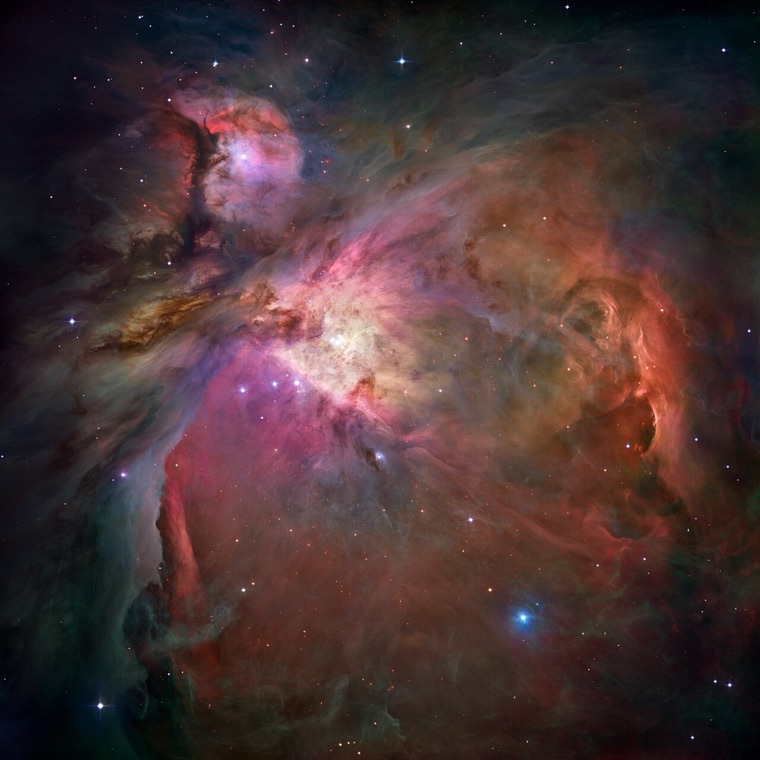
Orion Nebula
Nebula in Orion · 1,344 light-years
🔭 Explore Orion Nebula in the 3D map →View Orion Nebula images →The Orion Nebula (M42) is the nearest massive star-forming region to Earth, about 1,350 light-years away. It is not a single star: it is the softly glowing middle point in Orion's Sword, a cloud of gas and dust where new stars and planet-forming disks are being shaped by intense ultraviolet light.
| Type | Nebula |
|---|---|
| Constellation | Orion |
| Right ascension | 5h 35m 17s |
| Declination | −5° 23′ |
| Object distance | 1,344 light-years |
| Also known as | M42 |
| Imaged by | Hubble, JWST |
Observing Orion Nebula
Orion Nebula lies in the constellation Orion and is best placed in the evening sky around December. Its maximum altitude above the horizon depends on your latitude. Lying near the celestial equator, it can be seen from both hemispheres. Note that the listed magnitude is spread across the whole object — diffuse galaxies and nebulae are often harder to see than the number alone suggests, so dark, moonless skies help a great deal.
The nearby nursery inside Orion's Sword
The soft point in the middle of Orion's Sword looks almost stellar to an unaided eye, but it is an extended cloud: the Orion Nebula, also catalogued as Messier 42 and NGC 1976. Because this massive star-forming region is only about thirteen hundred and fifty light-years away, astronomers can examine stellar birth here in exceptional detail.
The bright nebula spans roughly twenty-four light-years. Hubble assembled a mosaic from hundreds of exposures and revealed more than three thousand stars across the field, including many that visible dust or simple faintness hides from human eyes. The light reaching us now began that journey around the seventh century.
Creation and erosion under the same ultraviolet light
Near the centre, four massive young stars form the familiar Trapezium. Its hottest member, Theta-one Orionis C, supplies most of the ionizing ultraviolet radiation that makes the surrounding gas glow and helps carve the cavity we see.
Hubble also resolves proplyds: newborn stars wrapped in disks of gas and dust containing the raw material from which planets may form. Yet the radiation illuminating the nebula also strips material from some nearby disks. Orion therefore lets astronomers watch star birth, possible planet formation and environmental erosion happening together rather than as separate stories.
What the famous colours really show
Outside under a reasonably dark sky, M42 usually appears as a faint grayish glow. The vivid published views are still observation data, but they combine filtered light from glowing hydrogen, oxygen and sulfur with infrared measurements and map those signals into visible colours. Long exposures reveal structure and colour that an unaided eye cannot collect.
A flight through the cloud requires a second distinction. Its measured scale and known physical ingredients can guide a visualization, but dust hides much of the interior and the exact three-dimensional geometry is not a photographed fact. Universe Finder labels that close view as explanatory visualization rather than presenting it as a literal camera journey.
How to find Orion Nebula tonight
Start with Orion's Belt: the unmistakable row of three evenly spaced stars. From the Belt, follow the conventional figure into the shorter line of Orion's Sword. The softly fuzzy middle point in that line is M42, the Orion Nebula.
The direction may not be literally down on your screen or in the sky because Orion rotates with time, location and hemisphere. Follow the Belt-to-Sword pattern instead of relying on one fixed page direction.
No telescope is required under a reasonably dark sky. Expect a small grayish glow rather than the colour of a long-exposure photograph; moonlight, haze, light pollution and eyesight all change how easily this diffuse object appears. Binoculars or a telescope reveal more structure.
For a location-specific view, open Orion Nebula in Universe Finder and use Tonight. The sky view provides current direction and altitude, while the three-dimensional view shows where M42 lies beyond the familiar outline of Orion.
The numbers — and how sure we are
Every value below carries its label from the episode research pack: MEASURED (observation-derived), ESTIMATE (model-derived or uncertain), COMPARISON (an analogy for scale), VISUALIZATION (explanatory rendering).
- MEASURED This is the Orion Nebula — Messier forty-two — the nearest massive star-forming region to Earth.identification and sky position are settledNASA Science (retrieved 2026-08-20) · Universe Finder catalog (retrieved 2026-08-20)
- MEASURED The fuzzy middle point in Orion's sword is not a star at all — it is a glowing cloud where stars are being born.the nebula is spatially extended; unaided-eye appearance varies with sky brightness and visual acuityNASA Night Sky Network (retrieved 2026-08-20) · NASA Science (retrieved 2026-08-20)
- MEASURED It lies about thirteen hundred and fifty light-years away — close enough for astronomers to study stellar birth in extraordinary detail.VLBA parallax gives 414 ± 7 pc, or about 1,350 ± 23 ly; Universe Finder displays 1,344 ly and NASA public pages often round to 1,500 lyMenten et al. 2007, A&A (retrieved 2026-08-20) · Universe Finder catalog (retrieved 2026-08-20)
- COMPARISON The light reaching you tonight left this nursery around the seventh century — more than a thousand years before the first space telescope.Menten et al. 2007, A&A (retrieved 2026-08-20)
- ESTIMATE The bright nebula spans roughly twenty-four light-years — light itself needs about twenty-four years to cross it.NASA's public observing guide quotes 24 light-years; the visible boundary depends on wavelength, sensitivity and where the surrounding Orion molecular complex is separated from M42NASA Night Sky Network (retrieved 2026-08-20)
- MEASURED At about magnitude four, M42 is visible without a telescope under a reasonably dark sky — usually as a soft, grayish point rather than the colour in long exposures.integrated magnitude does not predict diffuse-object visibility by itself; moonlight, haze, light pollution and eyesight strongly affect the viewNASA Science (retrieved 2026-08-20) · NASA Night Sky Network (retrieved 2026-08-20)
- MEASURED Find the three evenly spaced stars of Orion's Belt, then follow the short line of the Sword: the fuzzy middle point is the Orion Nebula.direction on the page depends on hemisphere and Orion's rotation in the sky; the Sword means the conventional figure, not screen-down at every time and locationNASA Night Sky Network (retrieved 2026-08-20) · Universe Finder catalog (retrieved 2026-08-20)
- MEASURED Near the centre, four massive young stars form the Trapezium. Its hottest member, Theta-one Orionis C, supplies most of the ultraviolet radiation that makes gas glow and carves the surrounding cavity.four principal stars define the familiar Trapezium; Theta-one Orionis C is the dominant source of the ionizing ultraviolet radiation discussed hereNASA Science (retrieved 2026-08-20) · STScI (retrieved 2026-08-20) · NASA Science (retrieved 2026-08-20)
- MEASURED Hubble's 520-exposure mosaic reveals more than three thousand stars across this field, many too faint or dust-hidden for human eyes alone.count refers to stars visible in the released Hubble mosaic, not a complete membership census and not proof every visible star formed inside M42STScI (retrieved 2026-08-20) · NASA Science (retrieved 2026-08-20)
- MEASURED Hubble also resolves proplyds — newborn stars surrounded by disks of gas and dust containing the raw material from which planets may form.proplyds are externally illuminated or photoevaporating protoplanetary disks; being a disk does not guarantee a finished planetary systemNASA Science (retrieved 2026-08-20) · NASA Science (retrieved 2026-08-20)
- MEASURED Here creation and erosion happen together: the ultraviolet radiation that makes the nebula shine is also stripping gas from some nearby planet-forming disks.external photoevaporation is observed; outcomes differ by disk mass, distance and exposure, so the evidence does not justify saying every disk or every future planet is destroyedNASA Science (retrieved 2026-08-20) · ESA/Webb (retrieved 2026-08-20)
- MEASURED The famous colours are observation data: filtered light from hydrogen, oxygen, sulfur and infrared wavelengths mapped into a visible image — not the faint gray view your eye gets outside.Hubble composites map filtered emissions and infrared data to display colours; camera exposure and processing reveal colour and structure the unaided eye does not seeNASA Science (retrieved 2026-08-20) · NASA Science (retrieved 2026-08-20)
- VISUALIZATION This flight through the cloud is a visualization: its scale and physical ingredients follow observations, but dust hides much of the interior and the exact three-dimensional geometry is simplified.NASA Science (retrieved 2026-08-20) · STScI (retrieved 2026-08-20)
Questions people ask
Is the middle star in Orion's Sword actually the Orion Nebula?
What looks like a soft middle star is not a single star. It is the extended glow of M42, a cloud of gas and dust where stars are forming. Follow Orion's three Belt stars to the shorter Sword line; the fuzzy middle point is the nebula.
Can I see the Orion Nebula without a telescope?
Yes. At about magnitude four, M42 is visible without a telescope under a reasonably dark sky, usually as a small grayish glow. Its visibility changes significantly with moonlight, haze, light pollution and eyesight, and it will not resemble the colourful long-exposure images.
How far away and how large is the Orion Nebula?
It is about 1,350 light-years away, and the bright nebula spans roughly twenty-four light-years. Light itself therefore needs about twenty-four years to cross that bright region, while the light reaching Earth tonight began its journey around the seventh century.
What is the Trapezium in the Orion Nebula?
The Trapezium is the group of four massive young stars near the nebula's centre. Its hottest member, Theta-one Orionis C, dominates the ultraviolet radiation that makes the gas glow and carves the surrounding cavity. That radiation also strips material from some nearby planet-forming disks.
Are the colours in Orion Nebula photographs real?
They represent real measured light, but not the unaided-eye view. Astronomical images combine filtered emissions and infrared observations, then map those measurements into visible colours. Outside, most people see a faint grayish glow; a three-dimensional flight through the hidden interior is additionally labeled as a visualization because the fine geometry is simplified.
See Orion Nebula in Universe Finder
Open the interactive 3D map to fly to Orion Nebula and see it in context among the real stars around it. Launch the 3D view →
Prefer to watch first? Watch the full Orion Nebula episode — a guided 3D flight with chapters, transcript and sources →
Sources
- Position and distance curated from published deep-sky catalogues (Messier / NGC / IC and the astronomical literature).
- Object identity cross-referenced with SIMBAD (CDS, Strasbourg).
- Image credits and the original observation source are linked with each photograph.
Related objects
- Ring Nebula — nebula
- Eagle Nebula — nebula
- Carina Nebula — nebula
- Lagoon Nebula — nebula
- Barbell Nebula — nebula