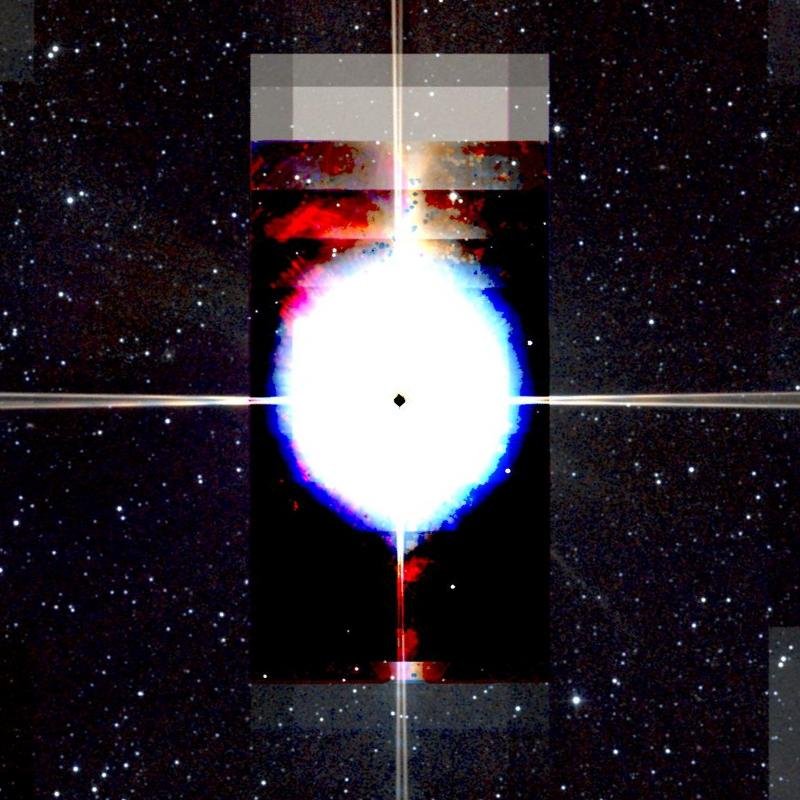
Betelgeuse
Star in Orion · ~550–720 light-years (estimates disagree)
🔭 Explore Betelgeuse in the 3D map →View Betelgeuse images →Betelgeuse (Alpha Orionis) is the red supergiant on Orion's shoulder — roughly 600 light-years away, about 760 times wider than the Sun, and already in the final chapters of its life. It will end as a supernova, on a timescale some models put within roughly 100,000 years. In Orion's season, find the Belt's three stars and look up-left for the brightest distinctly orange star.
| Type | Star |
|---|---|
| Constellation | Orion |
| Right ascension | 5h 55m 10s |
| Declination | +7° 24′ |
| Object distance | ~550–720 light-years (estimates disagree) |
| Apparent magnitude | 0.45 |
| Also known as | Spectral type M2Ib |
Observing Betelgeuse
Betelgeuse lies in the constellation Orion and is best placed in the evening sky around December. Its maximum altitude above the horizon depends on your latitude. Lying near the celestial equator, it can be seen from both hemispheres. At its brightness it can be found with the unaided eye under a dark sky and is easy in binoculars.
A dying giant on Orion's shoulder
Betelgeuse is what a massive star looks like near the end. Carrying somewhere between 14 and 19 times the Sun's mass, it burned through its main fuel supply in only about ten million years and swelled into a red supergiant about 760 times the Sun's width. Put it where the Sun is and its surface would reach past Mars into the asteroid belt; Mercury, Venus, Earth and Mars would all be inside the star.
The orange colour you see with your naked eye is physics on display: its surface runs around 3,600 kelvin, far cooler than the Sun's, and cooler means redder. What it lacks in temperature it repays in sheer area — summed over that enormous surface, Betelgeuse shines tens of thousands of times brighter than the Sun.
Even its distance is a live research question: roughly 600 light-years is the working figure, but published values still disagree — a reminder that measuring precise distances to huge, boiling, non-spherical stars is genuinely hard.
The Great Dimming — and the 2025 companion
Between late 2019 and early 2020, Betelgeuse visibly faded to about a third of its usual brightness — obvious to anyone who knew Orion, and briefly the subject of supernova speculation worldwide. The leading explanation, built from Hubble and ground-based observations, is less apocalyptic and more interesting: the star threw off a piece of itself; the ejected gas cooled into dust and, for months, that dust cloud hung in front of the star like a smoke screen.
The story gained a chapter in 2025, when astronomers reported directly detecting a long-predicted close companion star — a faint partner whose orbit may explain a six-year cycle in Betelgeuse's brightness that had puzzled observers for a century.
When it goes
Betelgeuse will explode as a supernova — that fate was sealed by its birth mass. The timing is the uncertain part: some models put the explosion within roughly one hundred thousand years, which is imminent on stellar timescales and unhelpfully vague on human ones.
When it happens, NASA's summary suggests the supernova could shine about as brightly as the full Moon — a once-in-civilization sky event, watched from a comfortable distance. Orion's shoulder will eventually go dark, and the constellation your descendants learn will be missing a star.
How to find Betelgeuse tonight
Betelgeuse belongs to Orion's season: northern winter evenings, roughly December through March, when Orion stands high in the south (or high in the north from the Southern Hemisphere, upside down).
Start with Orion's Belt — three moderately bright stars in a short, straight, evenly spaced row; nothing else in the sky looks quite like it. From the Belt, look to the figure's upper-left shoulder (upper-right from the Southern Hemisphere) for a bright star with an unmistakable orange tint. That colour is the giveaway: Betelgeuse is one of the few stars whose colour is obvious to the naked eye.
A useful thing to know while you look: Orion's familiar pattern only exists from Earth. Its stars lie at wildly different distances — Betelgeuse is not physically near the Belt stars at all — and moving a few dozen light-years sideways would dissolve the figure entirely. The 3D map demonstrates this directly: fly to Betelgeuse and watch Orion come apart behind you.
The Tonight panel in the map gives your local visibility, direction and altitude — and in the star's off-season it will honestly tell you to wait.
The numbers — and how sure we are
Every value below carries its label from the episode research pack: MEASURED (observation-derived), ESTIMATE (model-derived or uncertain), COMPARISON (an analogy for scale), VISUALIZATION (explanatory rendering).
- ESTIMATE It sits roughly 600 light-years away — and astronomers still argue about that number in published papers.genuinely hard to measure — recent studies span ~550 ly (Joyce 2020, seismology) to ~720 ly (Harper 2017, radio); the star is too bright for GaiaJoyce et al. 2020, ApJ 902, 63 (retrieved 2026-07-26) · Harper et al. 2017, AJ 154, 11 (retrieved 2026-07-26)
- ESTIMATE It is about 760 times wider than the Sun.estimates cluster ~640–880 R☉; adopted 760 tracks Joyce 2020 (764 +116/−62) — the surface is a heaving, ill-defined boundaryJoyce et al. 2020, ApJ 902, 63 (retrieved 2026-07-26) · Wikipedia (retrieved 2026-07-26)
- COMPARISON Put it where the Sun is, and its surface would reach past Mars, into the asteroid belt — Mercury, Venus, Earth and Mars would all be inside the star.Joyce et al. 2020, ApJ 902, 63 (retrieved 2026-07-26)
- MEASURED Its surface runs around 3,600 kelvin — cooler than the Sun, and that is why it glows orange.reported values 3,250–3,780 K; it genuinely varies as the star pulsatesWikipedia (retrieved 2026-07-26) · SIMBAD Astronomical Database (retrieved 2026-07-26)
- ESTIMATE All that surface adds up: it shines tens of thousands of times brighter than the Sun.estimates ~65,000–126,000 L☉, coupled to the distance uncertaintyJoyce et al. 2020, ApJ 902, 63 (retrieved 2026-07-26) · Wikipedia (retrieved 2026-07-26)
- ESTIMATE It carries somewhere between 14 and 19 times the Sun's mass — heavy enough that its fate was sealed at birth.model-derived; published range roughly 10–21 M☉ depending on methodJoyce et al. 2020, ApJ 902, 63 (retrieved 2026-07-26) · Wikipedia (retrieved 2026-07-26)
- ESTIMATE Betelgeuse is around ten million years old — and it is already dying.estimates span roughly 8–14 million years; 'around ten million' is the defensible centre (NASA overview agrees)Joyce et al. 2020, ApJ 902, 63 (retrieved 2026-07-26) · NASA Science (retrieved 2026-07-26)
- MEASURED Between late 2019 and early 2020, Betelgeuse visibly faded to about a third of its usual brightness — and then recovered.the fading itself is precisely measured (photometry + VLT imaging) — this fact covers the observation only; the cause is a separate, interpretive factMontargès et al. 2021, Nature 594 (retrieved 2026-07-26) · Wikipedia (retrieved 2026-07-26)
- ESTIMATE The leading explanation: the star threw off a piece of itself, the gas cooled into dust, and for a few months Betelgeuse hid behind its own smoke.an interpretation, not a settled fact — Hubble spectroscopy (Dupree 2022) supports a surface mass ejection; VLT imaging (Montargès 2021) supports dust forming over a cool surface patch; both agree dust did the hidingDupree et al. 2022, ApJ 936, 18 (retrieved 2026-07-26) · Montargès et al. 2021, Nature 594 (retrieved 2026-07-26) · NASA Science (retrieved 2026-07-26)
- ESTIMATE And in 2025, astronomers reported directly detecting a long-predicted close companion star — which may explain why Betelgeuse brightens and dims on a six-year cycle.reported as a probable detection of a long-predicted companion; confirmation and orbit refinement ongoingNASA/JPL news (retrieved 2026-07-26)
- ESTIMATE It will explode as a supernova. Some models put that within roughly one hundred thousand years; others allow much longer.model-dependent — timing hinges on mass, rotation and interior state, none directly observableJoyce et al. 2020, ApJ 902, 63 (retrieved 2026-07-26) · NASA Science (retrieved 2026-07-26)
- ESTIMATE When it happens, NASA's summary suggests the supernova could shine about as bright as the full Moon — and Earth, hundreds of light-years away, is far outside the danger zone.brightness is model-dependent — the NASA/NICER summary says the supernova could be 'as bright as the full moon'NASA HEASARC / NICER science nugget (2020-01-09) (retrieved 2026-07-26) · NASA Science (retrieved 2026-07-26) · ESO Supernova exhibition (retrieved 2026-07-26)
Questions people ask
When will Betelgeuse explode?
No one can give a date — and anyone who does is guessing. The star's mass guarantees a supernova ending, and some models put it within roughly one hundred thousand years, which is 'soon' only in stellar terms. The 2019–2020 Great Dimming was widely read as a warning sign, but the evidence points to ejected dust temporarily blocking the star's light, not a pre-explosion collapse.
Why did Betelgeuse go dim in 2020?
Between late 2019 and early 2020 it faded to about a third of its usual brightness. The leading explanation from Hubble and ground-based observations: Betelgeuse ejected a mass of gas from its own surface; the gas cooled into dust, and for months that dust hung between the star and Earth like a smoke screen. The star itself carried on fusing exactly as before.
Why is Betelgeuse orange-red?
Temperature. Its surface runs around 3,600 kelvin — much cooler than the Sun's — and cooler stellar surfaces emit redder light. The colour is plain to the naked eye, which is rare, and it is the quickest way to confirm you've found the right star on Orion's shoulder.
How big is Betelgeuse compared to the Sun?
About 760 times the Sun's width, with real uncertainty because the star is a boiling, ragged, non-spherical object whose 'edge' is genuinely fuzzy. The intuitive version: placed at the centre of our solar system, its surface would extend past the orbit of Mars — Mercury, Venus, Earth and Mars would all orbit inside the star.
Does Betelgeuse have a companion star?
In 2025 astronomers reported directly detecting a long-predicted faint close companion. Its existence had been suspected for decades because of a roughly six-year periodicity in Betelgeuse's brightness; the direct detection, if it holds up through follow-up observation, resolves a century-old puzzle.
See Betelgeuse in Universe Finder
Open the interactive 3D map to fly to Betelgeuse and see it in context among the real stars around it. Launch the 3D view →
Prefer to watch first? Watch the full Betelgeuse episode — a guided 3D flight with chapters, transcript and sources →
Sources
- Position and distance from the HYG stellar database (Hipparcos · Yale Bright Star · Gliese).
- Object identity cross-referenced with SIMBAD (CDS, Strasbourg).
- Image credits and the original observation source are linked with each photograph.
Related objects
- The Sun — star
- Proxima Centauri — star
- Barnard's Star — star
- TRAPPIST-1 — star
- Sirius — star