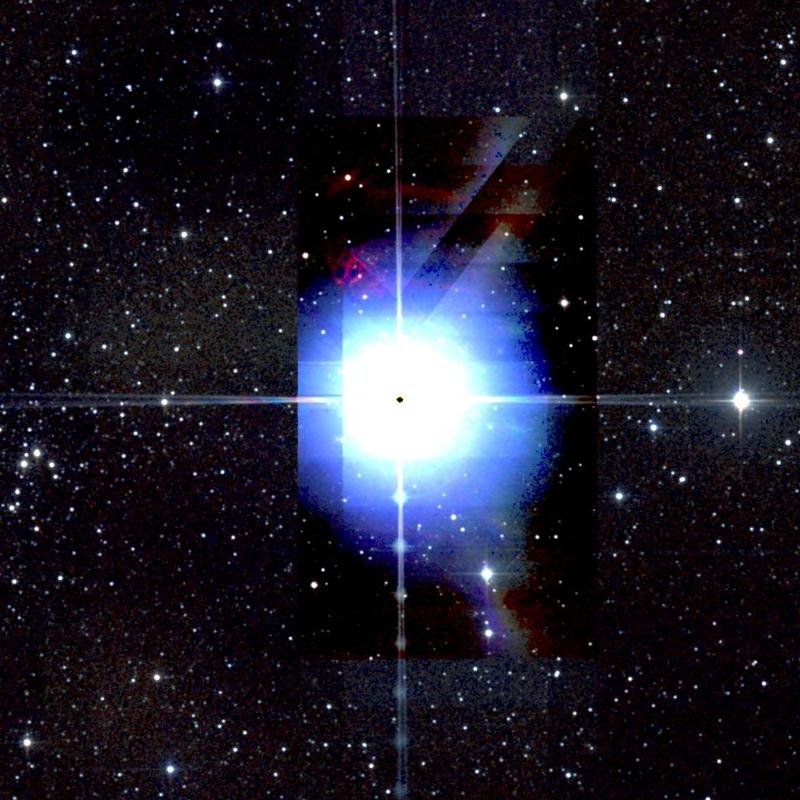
Sirius
Star in Canis Major · 8.6 light-years
🔭 Explore Sirius in the 3D map →View Sirius images →| Type | Star |
|---|---|
| Constellation | Canis Major |
| Right ascension | 6h 45m 09s |
| Declination | −16° 43′ |
| Object distance | 8.6 light-years |
| Apparent magnitude | -1.44 |
| Also known as | Spectral type A0m... |
The brightest star in Earth’s night sky, a hot blue-white star just 8.6 light-years away. It has a tiny white-dwarf companion, Sirius B.
Observing Sirius
Sirius lies in the constellation Canis Major and is best placed in the evening sky around December. Its maximum altitude above the horizon depends on your latitude. Lying near the celestial equator, it can be seen from both hemispheres. At its brightness it can be found with the unaided eye under a dark sky and is easy in binoculars.
See Sirius in Universe Finder
Open the interactive 3D map to fly to Sirius and see it in context among the real stars around it. Launch the 3D view →
Sources
- Position and distance from the HYG stellar database (Hipparcos · Yale Bright Star · Gliese).
- Object identity cross-referenced with SIMBAD (CDS, Strasbourg).
- Image credits and the original observation source are linked with each photograph.
Related objects
- The Sun — star
- Proxima Centauri — star
- Barnard's Star — star
- TRAPPIST-1 — star
- Rigil Kentaurus — star