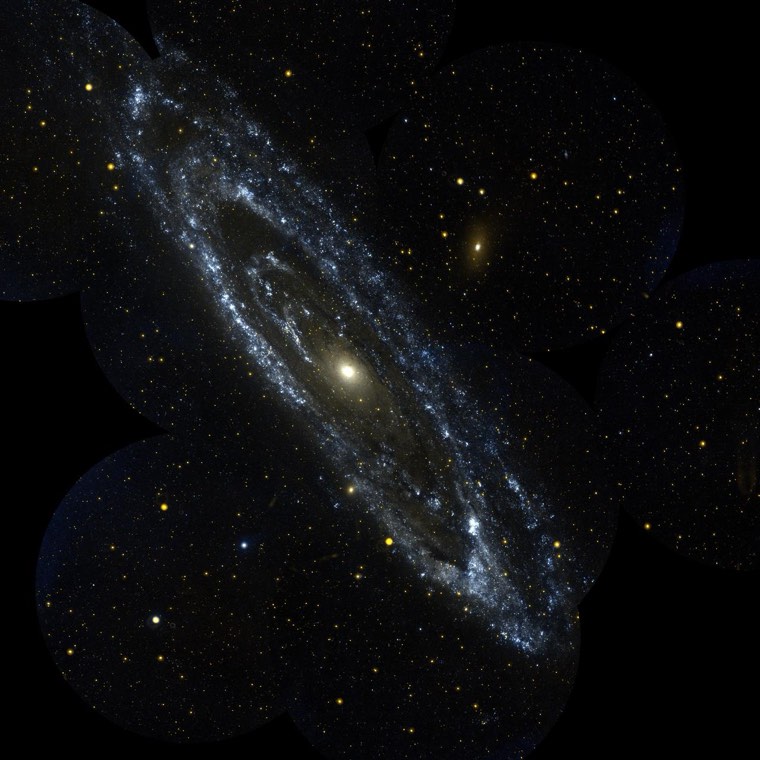
Andromeda Galaxy
Galaxy in Andromeda · 2.5 million light-years
🔭 Explore Andromeda Galaxy in the 3D map →View Andromeda Galaxy images →The Andromeda Galaxy (M31) is the nearest large galaxy to our own — about 2.5 million light-years away, roughly 150,000 light-years across, home to around a trillion stars — and under a reasonably dark sky it is the farthest thing most human eyes can see unaided. Find it from September onward by following the deeper dip of Cassiopeia's W, which points almost straight at it.
| Type | Galaxy |
|---|---|
| Constellation | Andromeda |
| Right ascension | 0h 42m 43s |
| Declination | +41° 16′ |
| Object distance | 2.5 million light-years |
| Also known as | M31 |
| Imaged by | Hubble, JWST |
Observing Andromeda Galaxy
Andromeda Galaxy lies in the constellation Andromeda and is best placed in the evening sky around September. Its maximum altitude above the horizon depends on your latitude. It is best placed for observers in the northern hemisphere, and sits low for those far south. Note that the listed magnitude is spread across the whole object — diffuse galaxies and nebulae are often harder to see than the number alone suggests, so dark, moonless skies help a great deal.
The farthest thing your eyes can see
At magnitude 3.4, Andromeda is genuinely visible without any equipment — a small elongated smudge under a reasonably dark sky. What your eye catches is only the galaxy's bright core: photographed properly, Andromeda is wider on our sky than six full Moons in a row. The light hitting your retina tonight left the galaxy around the dawn of early stone-tool making, some two and a half million years ago.
Distance is the thing that transformed Andromeda from a 'spiral nebula' into a galaxy in its own right — and Cepheid variable stars, the classic 'standard candles' that first settled that century-old debate, still anchor its distance today, now pinned to better than two percent. In 2025 the Hubble Space Telescope completed its largest photomosaic ever made — 2.5 gigapixels of Andromeda, resolving hundreds of millions of its stars individually.
The collision that isn't certain anymore
For years, popular astronomy repeated a confident story: Andromeda is approaching the Milky Way at about 110 kilometres per second, and in a few billion years the two must collide and merge. Half of that is still measured fact — the approach speed is real. The conclusion is not: modelling published in 2025, which folds in the gravitational influence of the Local Group's other members and the measured sideways motion, puts the odds of a merger within the next 10 billion years at roughly a coin flip.
If they do merge, the two spirals would settle into a single elliptical galaxy — and yet individual stars would almost certainly never collide with each other; the distances between stars are simply too vast. Both galaxies remain the two heavyweights of the Local Group either way.
How to find Andromeda Galaxy tonight
From September onward, Andromeda climbs the eastern sky after dark and stays well placed through northern autumn and winter evenings.
The reliable star-hop starts at Cassiopeia — the bright W (or M) of five stars that never sets for most northern latitudes. The W has two dips; the deeper one works like an arrowhead and points almost straight at Andromeda, about fifteen degrees away. Sweep that line with your eyes or binoculars and look for a small elongated glow.
Expectations matter: with the naked eye you are looking for a faint smudge, not a photograph. Binoculars show the bright core plainly and hint at the disc's extent; dark, moonless skies make the biggest difference of all, because the galaxy's light is spread across a huge area.
For your exact sky, open Andromeda in the 3D map — the Tonight panel computes visibility and direction for your location, and the map can then carry you across the 2.5-million-light-year gap to see the galaxy's position in the real three-dimensional neighbourhood.
The numbers — and how sure we are
Every value below carries its label from the episode research pack: MEASURED (observation-derived), ESTIMATE (model-derived or uncertain), COMPARISON (an analogy for scale), VISUALIZATION (explanatory rendering).
- MEASURED It lies about two and a half million light-years away — a distance now pinned to better than two percent.HST Cepheid P–L: 765 ± 12 kpc (~2.50 Mly, <2%); combined independent methods ~2.54 ± 0.06 MlyLi et al. 2021, ApJ 920, 84 (retrieved 2026-08-12) · NASA Hubble Messier Catalog (retrieved 2026-08-12)
- ESTIMATE It spans roughly a hundred and fifty thousand light-years — and where you call the edge is genuinely a judgment call, because a galaxy simply fades away.isophotal D25 ~46.6 kpc (~152,000 ly); popular figures up to ~220,000 ly trace fainter outskirts — a galaxy has no hard edgeWikipedia (retrieved 2026-08-12) · NASA Hubble Messier Catalog (retrieved 2026-08-12)
- ESTIMATE Roughly one trillion starsorder-of-magnitude population estimate; the Milky Way holds ~100–400 billionESA/Hubble release heic2501 (retrieved 2026-08-12) · NASA Hubble Messier Catalog (retrieved 2026-08-12)
- MEASURED At magnitude three point four — under a reasonably dark sky — it is the farthest thing most human eyes will ever see unaided.V ≈ 3.4 integrated; 'farthest naked-eye object' is the conventional record — M33 is arguable under exceptional skiesNASA Hubble Messier Catalog (retrieved 2026-08-12) · Sky & Telescope (retrieved 2026-08-12)
- MEASURED Photographed properly, it is wider on our sky than six full Moons in a row — your eye just catches the glowing core.~3.2° × 1° in long exposures; naked-eye extent is the central bulge onlyNASA Hubble Messier Catalog (retrieved 2026-08-12)
- MEASURED Approaching the Milky Way at ~110 km per second~110 km/s relative to the Milky Way (heliocentric ~−300 km/s); transverse motion small but decisive for the orbitNASA Science (retrieved 2026-08-12) · Wikipedia (retrieved 2026-08-12)
- ESTIMATE The famous collision is no longer a certainty: the best current modelling gives roughly even odds of a merger within ten billion years.Sawala et al. 2025 (Gaia+HST motions, M33 and LMC included): ~50% within 10 Gyr; earlier modelling (2012) had a near-certain merger in ~4–5 Gyr — model-dependent by definitionSawala et al. 2025, Nature Astronomy 9, 1206–1217 (retrieved 2026-08-12) · NASA Science (retrieved 2026-08-12) · van der Marel et al. 2012, ApJ 753, 9 (retrieved 2026-08-12)
- ESTIMATE The two galaxies would settle into a single elliptical — and yet individual stars would almost never collide, because the space between them is so vast.standard outcome of major-merger modelling; stellar collisions negligible because interstellar distances are vastvan der Marel et al. 2012, ApJ 753, 9 (retrieved 2026-08-12) · Wikipedia (retrieved 2026-08-12)
- MEASURED 2025: Hubble's largest photomosaic ever — 2.5 gigapixels, hundreds of millions of its stars resolved600+ pointings over 10+ years; individual stars resolved across the diskESA/Hubble release heic2501 (retrieved 2026-08-12) · ESA/Hubble image heic2501a (retrieved 2026-08-12)
- MEASURED With the Milky Way: the two heavyweights of the Local Groupthe Local Group's two dominant spirals by mass and luminosityNASA Hubble Messier Catalog (retrieved 2026-08-12) · Wikipedia (retrieved 2026-08-12)
- MEASURED From September onward, it climbs the eastern sky after dark.northern-hemisphere evening visibility; circumpolar-adjacent from high latitudesEarthSky (retrieved 2026-08-12) · Universe Finder curated catalogue (app/src/data/catalog.js) (retrieved 2026-08-12)
Questions people ask
Will the Andromeda Galaxy collide with the Milky Way?
It is no longer the certainty it was long presented as. Andromeda's approach speed (~110 km/s) is measured fact, but 2025 modelling that includes the rest of the Local Group and the measured sideways motion gives roughly even odds of a merger within the next 10 billion years. If a merger does happen, the result would be a single elliptical galaxy — with essentially no individual stars colliding, because interstellar distances are so vast.
Can I see Andromeda without a telescope?
Yes — that is its claim to fame. At magnitude 3.4 it is visible to the unaided eye under a reasonably dark sky, making it the farthest object most human eyes can see: about 2.5 million light-years. Expect a small elongated smudge near Cassiopeia, not the sweeping spiral of photographs — your eye only catches the bright core.
How big is Andromeda in the sky?
Far bigger than most people guess: photographed deeply, it spans more than six full Moons placed side by side. The disparity between that and the tiny smudge you see by eye comes down to surface brightness — the light is real but spread thin, which is why dark skies and low-magnification, wide-field instruments show it best.
How many stars does Andromeda have?
Roughly a trillion — several times the Milky Way's star count, spread across a disc around 150,000 light-years wide (where you call the 'edge' is genuinely fuzzy). In 2025 Hubble's largest-ever photomosaic resolved hundreds of millions of them individually along one flank of the galaxy.
See Andromeda Galaxy in Universe Finder
Open the interactive 3D map to fly to Andromeda Galaxy and see it in context among the real stars around it. Launch the 3D view →
Prefer to watch first? Watch the full Andromeda Galaxy episode — a guided 3D flight with chapters, transcript and sources →
Sources
- Position and distance curated from published deep-sky catalogues (Messier / NGC / IC and the astronomical literature).
- Object identity cross-referenced with SIMBAD (CDS, Strasbourg).
- Image credits and the original observation source are linked with each photograph.
Related objects
- Triangulum Galaxy — galaxy
- Whirlpool Galaxy — galaxy
- Sombrero Galaxy — galaxy
- Messier 110 — galaxy
- Messier 32 — galaxy