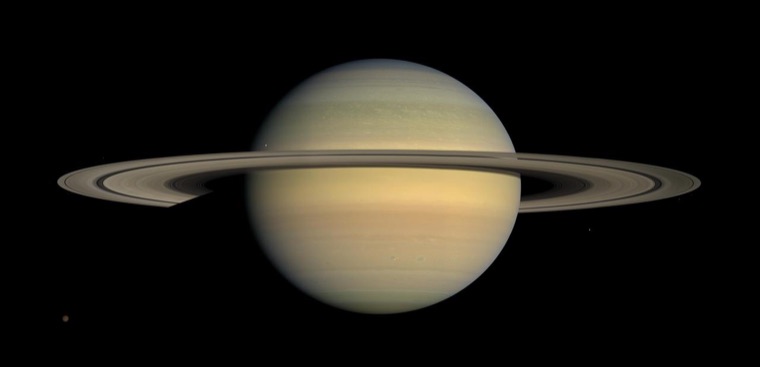
Saturn
Solar System · 9.6 AU from the Sun
🔭 Explore Saturn in the 3D map →View Saturn images →Saturn is the sixth planet from the Sun. Its rings can almost disappear from Earth's view when seen edge-on, but that is different from losing ring material. Ring rain is a physical flow of material into Saturn; estimates of how long the rings could survive depend on whether measured loss rates persist, and their age remains debated.
| Type | Solar System |
|---|---|
| Object distance | 9.6 AU from the Sun |
A vast ring system that can become a hairline
Saturn's main ring system, measured through the narrow F ring, spans about 280,000 kilometres. Its typical thickness is only about ten metres, although local structures can be much thicker. The enormous difference between width and thickness helps explain why a familiar broad ring system becomes so difficult to see edge-on.
About every fifteen years Earth passes through the ring plane. The rings have not physically disappeared: our line of sight has changed. Hubble photographed the edge-on rings on 22 May 1995, and its images from 1996 to 2000 show them opening again year by year. These observations separate a viewing-angle effect from any actual loss of material.
Ring rain is real loss, not a countdown
Saturn's gravity and magnetic field pull charged icy grains from the rings into the planet. Infrared observations of the atmosphere imply an influx that could fill an Olympic-size swimming pool about every half hour. This is an inferred rate, not a direct weighing of falling ice.
Ring rain alone would empty the rings in about three hundred million years at the estimated rate. Including the additional equatorial infall Cassini measured gives a shorter estimate, under a hundred million years, if those rates persist. The equatorial influx may be transient, and loss rates can vary. These scenarios are not a date on which Saturn is known to become ringless.
Why the rings' age is still debated
Cassini's final measurements put the rings' mass at about forty percent of the moon Mimas. Combining low mass and relatively clean ice with assumptions about incoming contamination has led to young-ring estimates. But exposure to pollution is not automatically the same as physical age.
Newer models show that rings can retain little of the contaminating material from impacts, allowing old rings to look young. The episode presents both readings rather than treating a young age as settled. Cassini spent thirteen years in orbit at Saturn; its observations continue to constrain this unresolved history.
How to find Saturn tonight
Saturn can appear to the unaided eye as a bright, steady, yellowish point. Whether it is available to you tonight depends on your location, the time and the sky conditions; this page does not promise it is above your horizon now.
Use the Explore Saturn button to search for Saturn and take the Universe Finder flight. The catalogue flight helps you explore the target; it is a symbolic visualization, not a scale model of the Solar System or a guarantee of tonight's viewing conditions.
The numbers — and how sure we are
Every value below carries its label from the episode research pack: MEASURED (observation-derived), ESTIMATE (model-derived or uncertain), COMPARISON (an analogy for scale), VISUALIZATION (explanatory rendering).
- MEASURED Saturn is the sixth planet from the Sun and the farthest planet known since antiquity — the farthest easily seen with the unaided eye.NASA Science (retrieved 2026-09-02) · Universe Finder catalog (retrieved 2026-09-02)
- MEASURED Saturn's main ring system is about two hundred and eighty thousand kilometres across, yet typically only about ten metres thick.The approximately 280,000 km SPAN is derived from Cassini ring geometry through the narrow F ring (F-ring radius ≈ 140,200 km ⇒ ≈ 280,400 km across), rounded to two significant figures.NASA Science (retrieved 2026-09-02) · NASA (retrieved 2026-09-03)
- MEASURED About every fifteen years Earth passes through the ring plane; the rings turn exactly edge-on and, from Earth, all but vanish.the cycle alternates roughly 13.75 and 15.75 years (half a Saturn orbit); NASA/STScI says 'approximately every 15 years'NASA/STScI (retrieved 2026-09-02)
- ESTIMATE Saturn's gravity and magnetic field pull charged icy grains out of the rings and down into the planet as 'ring rain' — observations imply a rate that could fill an Olympic swimming pool about every half hour.Keck infrared spectroscopy of H3+ emission (O'Donoghue et al. 2019, Icarus): the influx is INFERRED from the atmosphere's response, not weighed — an estimateNASA Goddard (retrieved 2026-09-02) · O'Donoghue et al. 2019, Icarus 322, 251 (retrieved 2026-09-02)
- ESTIMATE Ring rain alone would empty the rings in about three hundred million years; if the extra material Cassini saw falling in near the equator kept falling at that rate, they would be gone in under a hundred million.NASA/Goddard 2018: ring rain alone empties the rings in ~300 Myr; adding the equatorial influx Cassini measured during the Grand Finale gives < 100 Myr — IF those measured rates are characteristic.NASA Goddard (retrieved 2026-09-02) · Space Science Reviews 2025 (retrieved 2026-09-03)
- ESTIMATE Cassini's final measurements weighed the rings at about forty percent of the moon Mimas — so light and so clean that one reading puts their age at only ten to a hundred million years, though newer models allow rings far older that simply stay clean.Hyodo, Genda & Madeira (Nature Geoscience, 2025) show impactor material is poorly retained, so old rings can look young; the 2025 Space Science Reviews review treats physical age as unresolved (hundreds of millions to billions of years). No consensus is claimedIess et al. 2019, Science 364, eaat2965 (retrieved 2026-09-02) · NASA/JPL (retrieved 2026-09-02) · Hyodo, Genda & Madeira 2025, Nature Geoscience (retrieved 2026-09-03) · Space Science Reviews 2025 (retrieved 2026-09-03)
- MEASURED This is Saturn as NASA's Cassini spacecraft saw it in twenty sixteen, near the end of thirteen years in orbit.NASA Science (retrieved 2026-09-02) · NASA/JPL-Caltech/Space Science Institute (retrieved 2026-09-02)
- MEASURED These Hubble photographs, taken from nineteen ninety-six to two thousand, show the rings opening up year by year.ESA/Hubble opo0115a: a sequence of Hubble WFPC2 images from 1996 to 2000 as Saturn's rings tilted from near edge-on toward openESA/Hubble (retrieved 2026-09-02)
- MEASURED Hubble photographed the rings edge-on on the twenty-second of May, nineteen ninety-five — a planet with a hairline.NASA/STScI (retrieved 2026-09-02)
- MEASURED Saturn is the farthest planet you can easily see with your own eyes: a bright, steady, yellowish point in the night sky.NASA Science (retrieved 2026-09-02)
Questions people ask
Do Saturn's rings really disappear?
When viewed edge-on, the thin rings can all but disappear from Earth's view without vanishing physically. Ring rain is a separate process in which material actually leaves the rings and enters Saturn.
When will Saturn lose its rings?
There is no established countdown. Estimates depend on which measured loss processes are included and whether their rates continue. The episode distinguishes ring rain alone from additional equatorial infall, which may be transient.
Are Saturn's rings young or old?
Their physical age is unresolved. Low mass and clean ice support a young interpretation under particular contamination assumptions; models with poor retention of impactor material allow much older rings to remain clean.
Can I see Saturn without a telescope?
Saturn is readily visible to the unaided eye under suitable conditions as a bright, steady, yellowish point. That is a view of the planet as a point of light, not the detailed ring system shown in spacecraft and Hubble images.
See Saturn in Universe Finder
Open the interactive 3D map to fly to Saturn and see it in context among the solar system. Launch the 3D view →
Prefer to watch first? Watch the full Saturn episode — a guided 3D flight with chapters, transcript and sources →