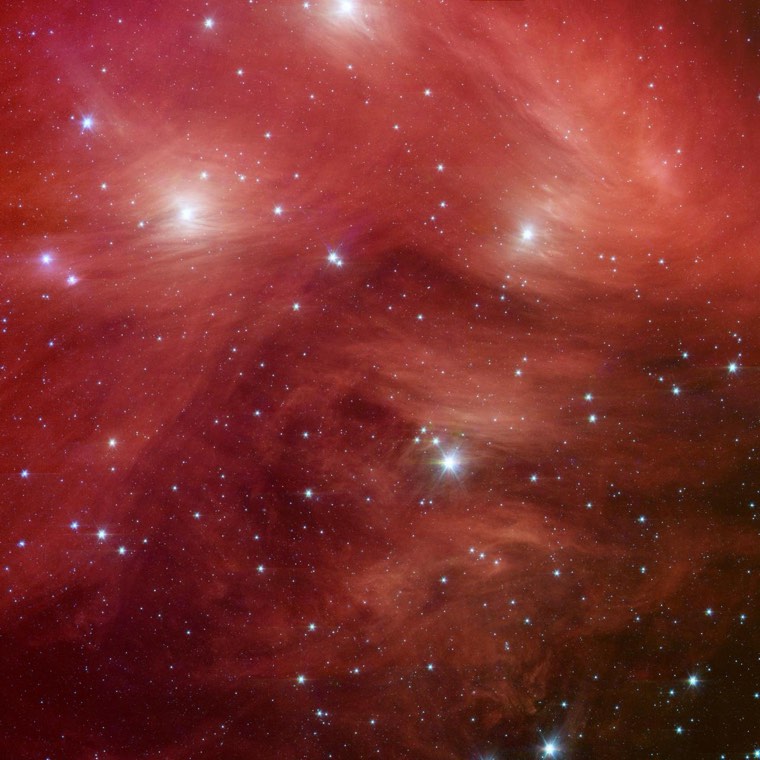
Pleiades
Star cluster in Taurus · 444 light-years
🔭 Explore Pleiades in the 3D map →View Pleiades images →The Pleiades (M45, the Seven Sisters) is one of the nearest and brightest open star clusters — about 444 light-years away, roughly 100 million years old, with about 1,000 identified member stars behind the handful your eye picks out. It is easy to find from October through April: follow the line of Orion's Belt past the bright orange star Aldebaran, and the tiny dipper-shaped knot just beyond is the Pleiades.
| Type | Star cluster |
|---|---|
| Constellation | Taurus |
| Right ascension | 3h 47m 24s |
| Declination | +24° 07′ |
| Object distance | 444 light-years |
| Also known as | M45 · Seven Sisters |
| Imaged by | Hubble |
Observing Pleiades
Pleiades lies in the constellation Taurus and is best placed in the evening sky around November. Its maximum altitude above the horizon depends on your latitude. It is best placed for observers in the northern hemisphere, and sits low for those far south.
What the Pleiades actually is
What looks like a tight little dipper of six stars is the bright heart of a genuine star cluster: about 1,000 identified members, born together and still travelling together, with a dense core a few light-years across and a gravitational grip reaching out to roughly 43 light-years. The stars you see are simply the brightest few of a family your eye cannot resolve.
In 2025 the family got dramatically bigger. Using NASA's TESS spacecraft together with Gaia's precision measurements, astronomers connected the bound cluster to a much larger dissolving population — more than 3,000 related stars spread across roughly 1,900 light-years, the 'Greater Pleiades Complex'. The cluster we see is the surviving bound heart of that enormous family, and like most open clusters, it too will eventually disperse.
None of this is guesswork about a fuzzy patch: the European Space Agency's Gaia mission has measured individual distances and motions for hundreds of the members, which is what makes the cluster's three-dimensional structure — a real cloud of stars, not a flat pattern — something you can actually fly through in the 3D map above.
Seven named, about six seen
The 'Seven Sisters' name is ancient, but most people under a typical sky count about six stars; under an excellent dark sky, careful observers can pick out a dozen or more. That gap between the name and the count has been noticed for a very long time — cultures separated by oceans named this same little knot of stars: Subaru in Japan, Matariki to the Māori — and one proposed hypothesis suggests the seven-sisters tale could be among humanity's oldest shared stories.
The moment anyone points an instrument at it, the truth comes out. In 1610 Galileo aimed one of the first astronomical telescopes at the Pleiades and drew thirty-six stars where his eyes had seen six — one of the earliest published demonstrations that the sky holds far more than the eye can catch. Even ordinary binoculars today repeat his experiment beautifully.
The blue glow is not what it looks like
Long-exposure photographs show the cluster wrapped in wisps of blue light, brightest around the star Merope. For most of a century that was assumed to be leftover material from the cluster's birth. It isn't: spectra and radio maps show the gas is moving at a distinctly different velocity from the stars — the Pleiades is simply passing through an unrelated interstellar dust cloud, and the blue is starlight scattering off dust grains in a chance encounter.
At about 100 million years old, the cluster shed its true birth cloud long ago. The blue nebulosity is a photobomb, not a baby picture.
How to find Pleiades tonight
Season first: from October through April in the Northern Hemisphere the Pleiades rides high on clear evenings — it is a winter-sky landmark, climbing the eastern sky after dark in late autumn and standing at its highest on midwinter evenings.
The classic star-hop takes seconds. Find the three-star line of Orion's Belt — one of the easiest patterns in the sky — and extend that line up and to the right (away from bright blue-white Sirius). It passes near the bright orange star Aldebaran, the eye of Taurus. Keep going a little farther and you arrive at a tiny, unmistakable dipper-shaped knot of stars small enough to cover with your thumb at arm's length: that is the Pleiades.
No equipment is needed — this is one of the sky's best naked-eye objects. Binoculars are the single best upgrade: the six stars become dozens, filling the field the way Galileo's first telescope did. On our sky the cluster spans about two degrees — four full Moons side by side — which is why low magnification beats a big telescope here.
Want tonight's specifics for your own location? Open the Pleiades in the 3D map and use the Tonight panel — it computes visibility for your sky, points you in the right compass direction, and can fly you into the cluster's real three-dimensional structure afterwards.
The numbers — and how sure we are
Every value below carries its label from the episode research pack: MEASURED (observation-derived), ESTIMATE (model-derived or uncertain), COMPARISON (an analogy for scale), VISUALIZATION (explanatory rendering).
- MEASURED It lies about four hundred and forty-four light-years away — a distance astronomers argued over for twenty years, until radio interferometry and Gaia settled it.VLBI parallax 136.2 ± 1.2 pc (Melis et al. 2014); Gaia DR2 cluster distance 135.8 ± 0.1 pc (Gaia Collaboration 2018) — Hipparcos's 120.2 ± 1.5 pc was the outlierMelis et al. 2014, Science 345, 1029 (retrieved 2026-08-16) · Gaia Collaboration et al. 2018 (Gaia DR2) (retrieved 2026-08-16) · Galli et al. 2017, A&A 598, A48 (retrieved 2026-08-16)
- ESTIMATE The cluster is roughly a hundred million years old — its stars ignited while dinosaurs still walked the Earth.lithium depletion boundary age 125 ± 8 Myr (Stauffer et al. 1998); isochrone fits ~100 Myr; NASA's release quotes ~100 Myr — the spoken 'roughly a hundred million years' sits at the conservative end of a well-bounded rangeStauffer, Schultz & Kirkpatrick 1998, ApJ 499, L199 (retrieved 2026-08-16) · NASA SVS 14928 (retrieved 2026-08-16)
- ESTIMATE About 1,000 identified members in the traditional cluster — the seven you know are just the brightest~1,000 identified members of the traditional cluster (NASA's 'loose grouping of about 1,000 members'); membership is probabilistic and lists vary by survey depth. Boyle et al. 2025 describe the FAMILIAR Pleiades as the gravitationally bound core of the dispersing Greater Pleiades Complex — boundness is the core's property, backed also by structure work (Adams et al. 2001)Boyle et al. 2025, ApJ (retrieved 2026-08-16) · NASA SVS 14928 (retrieved 2026-08-16) · Adams et al. 2001, AJ 121, 2053 (retrieved 2026-08-16) · Royal Observatory Greenwich (retrieved 2026-08-16)
- ESTIMATE In twenty twenty-five, astronomers identified a greater Pleiades family: more than three thousand stars — roughly three times the population previously associated with the cluster — streaming across nineteen hundred light-years.Boyle et al. 2025 (TESS rotation ages + Gaia kinematics + chemistry): >3,000 stars in the full Greater Pleiades Complex, ≈3× the previously associated population; complex membership is statistical; the dispersal mechanism (supernova history + galactic tides) is standard cluster physicsBoyle et al. 2025, ApJ (retrieved 2026-08-16) · NASA SVS 14928 (retrieved 2026-08-16)
- ESTIMATE Look up and most eyes catch about six stars; under an excellent dark sky, careful observers can pick out ten or more.an observational estimate, not a single measurement: the visible count varies with eyesight, dark adaptation, sky darkness, and which close pairs resolve — ~six is conventional; keen dark-adapted observers report 10–14. Cultural seven-vs-six material lives in pleiades.antiquityRoyal Observatory Greenwich (retrieved 2026-08-16) · Norris & Norris 2021 (retrieved 2026-08-16)
- MEASURED On our sky the cluster spans about two degrees — four full Moons, side by side.apparent extent ~110 arcmin for the bright core grouping; the bound cluster extends furtherWikipedia (retrieved 2026-08-16) · Royal Observatory Greenwich (retrieved 2026-08-16)
- ESTIMATE Core radius: a few light-years (sample- and model-dependent); tidal radius: roughly 43 light-yearsRADII, both. The core radius depends on the stellar-mass sample and the fitted profile — 'a few light-years' is the honest precision (2MASS-era fits cluster near ~2-3 pc for some samples); the tidal radius is ~43 ly (~13.1 pc, Adams et al. 2001). Dispersal simulations ~250 Myr; the 2025 complex shows the WIDER FAMILY's shedding long begun — the bound core persistsAdams et al. 2001, AJ 121, 2053 (retrieved 2026-08-16) · Wikipedia (retrieved 2026-08-16)
- MEASURED That famous blue glow was long assumed to be leftover birth material — it is actually an unrelated interstellar cloud the cluster is passing through, caught in the stars' light.White 2003 (ApJS): stellar spectra + CO maps show the cloud's radial velocity offset ~11 km/s from the cluster — a chance encounter with approaching cloud(s), not birth materialWhite 2003, ApJS 148, 487 (retrieved 2026-08-16) · Sky & Telescope (retrieved 2026-08-16) · ESA/Hubble opo0036a (retrieved 2026-08-16) · NASA/Hubble release 2004-20 (retrieved 2026-08-18)
- MEASURED From October through April in the Northern Hemisphere, it rides high on clear evenings — winter's most recognizable deep-sky sight.northern-hemisphere evening visibility window per NASA's guideNASA SVS 14928 (retrieved 2026-08-16) · Star Walk (retrieved 2026-08-16)
- MEASURED In sixteen ten, Galileo pointed one of the first telescopes at them and drew thirty-six stars where his eyes had seen six.historical record: Galileo's published Pleiades diagram in Sidereus Nuncius (1610) records 36 stars — the count is his published figure, not a modern remeasurementGalileo Galilei 1610 (retrieved 2026-08-16)
Questions people ask
Why is it called the Seven Sisters if I can only see six stars?
Most eyes catch about six stars under a typical sky, and the seventh sister has been described as 'lost' in stories going back millennia. The count is real physics, not myth: several of the named stars sit close to the naked-eye brightness limit, so sky quality and eyesight decide whether you see five, six, or — under an excellent dark sky — a dozen or more. The episode research keeps the two ideas separate on purpose: seven named, about six seen.
How far away is the Pleiades, really?
About 444 light-years — but that number has a famous history. The Hipparcos satellite measured a distance around 120 parsecs, in conflict with every other technique, and the disagreement took nearly twenty years to resolve. Radio interferometry and Gaia's parallaxes settled it at roughly 136 parsecs (~444 light-years); the light arriving at your eye tonight left the cluster around the year 1582.
Is the blue glow around the Pleiades its birth nebula?
No — that is one of astronomy's better-known corrections. The blue reflection nebulosity, brightest near Merope, comes from an unrelated interstellar dust cloud the cluster happens to be passing through. Measured velocities show the gas and the stars are not moving together, which rules out leftover birth material. The cluster is around 100 million years old and dispersed its true natal cloud long ago.
Is the Pleiades falling apart?
The larger Pleiades family is dispersing, while the familiar cluster remains its bound core: in 2025 astronomers connected the bound cluster to a family of more than 3,000 related stars spread across roughly 1,900 light-years, most of it drifting apart. Like most open clusters, that bound core will eventually disperse too — on timescales of tens to hundreds of millions of years, so no one alive will notice the difference.
When is the best time to see the Pleiades?
October through April in the Northern Hemisphere, on any clear evening — no special event needed. It is high and well-placed through the winter months. The Tonight panel in the 3D map computes exact visibility, direction and altitude for your own location and date.
See Pleiades in Universe Finder
Open the interactive 3D map to fly to Pleiades and see it in context among the real stars around it. Launch the 3D view →
Prefer to watch first? Watch the full Pleiades episode — a guided 3D flight with chapters, transcript and sources →
Sources
- Position and distance curated from published deep-sky catalogues (Messier / NGC / IC and the astronomical literature).
- Object identity cross-referenced with SIMBAD (CDS, Strasbourg).
- Image credits and the original observation source are linked with each photograph.
Related objects
- Hercules Cluster — star cluster
- Small Sgr Star Cloud — star cluster
- Messier 25 — star cluster
- Messier 103 — star cluster
- Messier 34 — star cluster